Workforce Elasticity – The New Framework for Retail Operations

Ethan Ward
Author
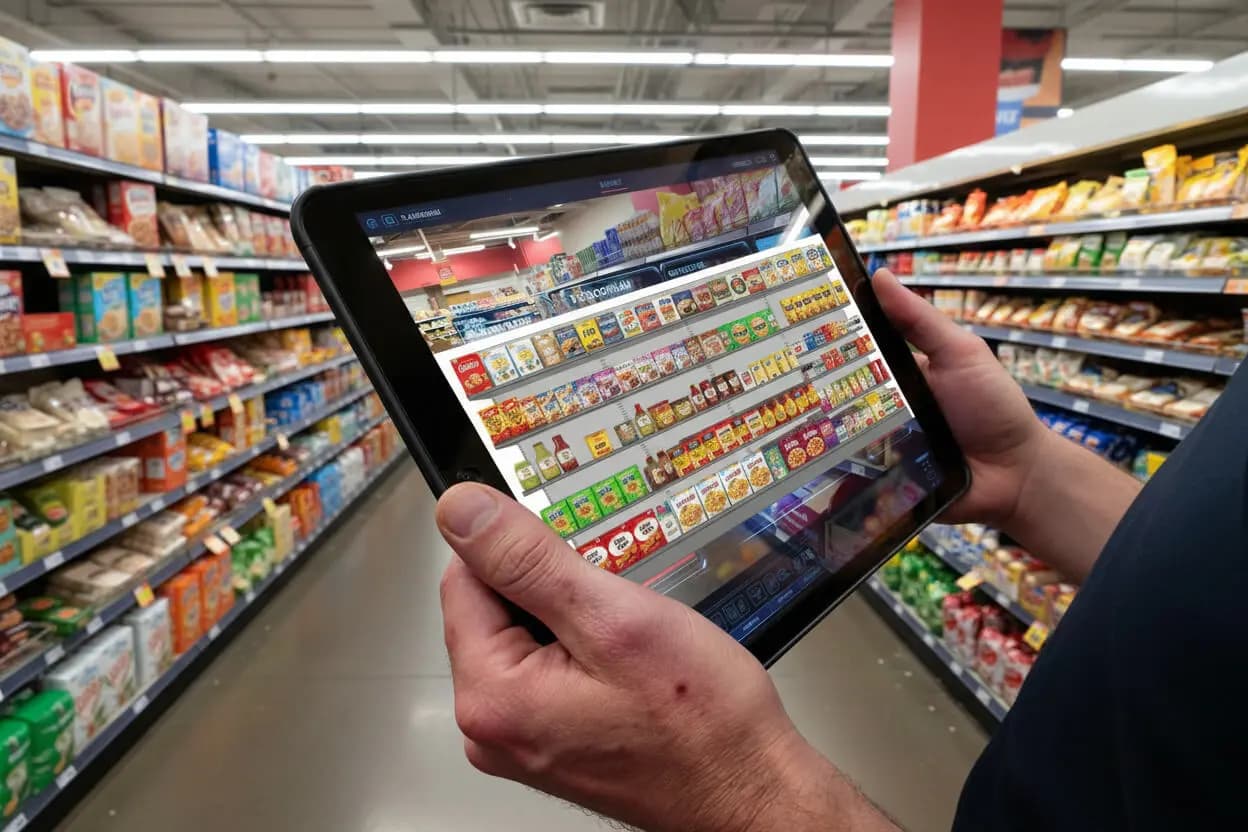
In the current retail landscape, the "Last Yard"— the final distance between the warehouse dock and the customer’s shopping cart—has become the most expensive territory in the supply chain. As we move through 2026, the retail merchandising industry is facing a structural reckoning.
Traditional staffing models are failing to keep pace with a market defined by $125 billion in annual losses, a softening labor market, and the rapid rise of "Agentic" commerce. For enterprise decision-makers, the goal is no longer just "having bodies on the floor." The goal is Precision Labor.
The $125 Billion Compliance Gap
Recent data reveals a staggering reality: poor visual merchandising and planogram non-compliance are costing retailers $125 billion in lost sales annually. This isn't just a matter of messy shelves; it is a fundamental breakdown in "Speed to Shelf" metrics.
When a planogram reset is executed incorrectly, it creates "Planogram Drift." This is a state where the physical shelf no longer matches the digital inventory record. In a world where 87% of retailers have deployed AI to manage replenishment, Planogram Drift acts like "noise" in the system, causing AI engines to trigger incorrect orders or fail to recognize out-of-stock items.
The 2026 Labor Paradox: Scarcity Amidst Softening
The labor market in 2026 presents a unique challenge for Retail Ops. While overall job gains have slowed—dropping from a monthly average of 103k in 2025 to just 30k per month in 2026—the turnover rate for retail positions remains high at nearly 4%.
Retailers are caught in a paradox: it is harder to find high-quality, full-time talent, yet the technical requirements of the job are increasing. Merchandising is no longer "stocking shelves"; it is a technical role involving:
RFID-Enabled Traceability: Managing "smart packaging" that feeds real-time data to corporate HQ.
ESL Synchronization: Coordinating Electronic Shelf Labels with dynamic pricing engines that update based on competitor SKU velocity.
Hyper-Local Assortment: Executing store-specific layouts that cater to regional value-seeking behaviors, which are projected to drive Private Label sales to $277 billion this year.
Moving from Static Teams to Workforce Elasticity
To combat these headwinds, leading retailers are abandoning the "Fixed Headcount" model in favor of Workforce Elasticity. By utilizing a labor marketplace like HireApp, companies can deploy "Specialist Squads" that are:
Tech-Native: 49% of traditional retail staff cite a lack of time or training to use modern analytical tools. HireApp contractors are vetted for their ability to use mobile audit tools and AR-layout assistants.
Audit-Ready: Because every shift is backed by photographic "Proof of Work," the $125 billion loss caused by non-compliance is mitigated at the source.
Cost-Efficient: Transitioning to on-demand labor reduces the "Cost-to-Serve" by eliminating the overhead of underutilized full-time staff during non-peak hours.
In the history of retail management, labor has almost always been treated as a fixed "cost of doing business." You hired a team, trained them, and hoped that the peaks of your demand would align with the hours on their contracts. But in 2026, the delta between labor supply and consumer demand has become too volatile for the fixed model to survive.
Enter Workforce Elasticity. Workforce Elasticity is the ability of a retail organization to expand and contract its human capital in real-time, based on live data signals. It is the transition from a "Static Headcount" to a "Dynamic Capacity."
The "Waste vs. Want" Paradox
Traditional retail staffing leaves VPs of Operations trapped in a constant cycle of "Waste" or "Want."
The Waste: During slow periods, you are paying for full-time staff to perform "busy work" or stand idle, eroding your operating margins.
The Want: During seasonal peaks, product launches, or major resets, your fixed team is overwhelmed. This leads to burnout, high turnover, and—most importantly—non-compliance on the floor.
Elasticity solves this by establishing a "Core + Flex" model. You maintain a lean, high-level core team of internal leaders and use an on-demand marketplace like HireApp to instantly "flex" your capacity during high-stakes projects.
The Financial Shift: Fixed to Variable (CapEx vs. OpEx)
From a CFO’s perspective, Workforce Elasticity is a balance sheet revolution. Fixed labor is a rigid liability. If sales drop by 15%, your labor cost remains at 100%. This is how retail businesses go underwater during economic shifts.
By shifting a portion of your merchandising and installation budget to a variable, on-demand model:
You Pay for Results, Not Presence: You aren't paying for someone to be "at the store"; you are paying for a specific merchandising reset to be completed.
Zero-Overhead Scaling: You can launch a national reset across 200 cities simultaneously without the massive HR overhead of hiring, onboarding, and insuring 500 new temporary employees.
The "Right-Sized" Shift: If a project that was supposed to take eight hours only takes six because you used a high-skilled HireApp pro, your costs drop immediately.
Breaking the "Speed to Shelf" Barrier
The most critical metric in 2026 is Speed to Shelf (STS). Every day a product sits in the backroom instead of on the display is a day of 0% ROI.
In a fixed labor model, if a shipment arrives early or a display is damaged, you have to wait for the next scheduled shift to address it. With an elastic workforce, you can trigger a "Rapid Response" shift the moment the delivery is scanned into the warehouse. This reduces your STS from 72 hours to less than 12 hours. In high-turnover categories like grocery or fast-fashion, that 60-hour difference is the margin that defines a successful quarter.
The "Tribal Knowledge" Trap
A common argument against elasticity is the loss of "store knowledge." However, in 2026, data has replaced tribal knowledge. With digital planograms, RFID-tracking, and real-time audit tools, a HireApp pro doesn't need to "know where things are" through years of habit. They follow the digital blueprint. In fact, because they move between different retail environments, they often bring best-practice "cross-pollination"—noticing inefficiencies that a long-term employee might have become blind to.
Technology as the Elasticity Engine
You cannot have elasticity without an "Engine." This is where the platform comes in. To manage an elastic workforce, you need:
Real-Time Bench Strength: Access to a vetted pool of pros in every zip code (like the 200+ cities HireApp covers).
Instant Dispatch: The ability to post a project and have it claimed by a qualified pro within minutes.
Automated Compliance: A way to verify that the "elastic" worker performed to the same standard as your "core" worker.
Conclusion
Workforce Elasticity isn't just a staffing trend; it’s a survival strategy for a low-margin, high-volatility world. By decoupling your operational capacity from your fixed headcount, you give your business the "breathing room" it needs to grow without the weight of unnecessary overhead.